Monday, September 21, 2015

Cottonwoods, Utilities Lines & Dogs

Our valley gets only 12 inches of precipitation per year (semi-arid).  It's covered in grass, with stands of shrubs here and there.  Greens are subdued—the gray-greens and blue-greens of drought-tolerant plants.  But where there's water, everything’s different.  Cottonwoods, willows, tall grasses and sedges line streams, and the greens are rich and deep.

Here’s a Google Earth view of the Laramie Valley.  Our town on the southeast edge.  Dark green riparian zones and occasional irrigated fields line creeks and rivers.
 The green arrows above and below show where my foot was stuck on Saturday.
Laramie West Side and river.
Why was it stuck?  Because every two months, Lucy Corrander of Loose and Leafy kindly hosts a stuck-foot meme:
“… plant your foot firmly in a roughly random place and see what you can see without moving. Best is when you plant both feet. If you are on a slope or some other kind of difficult ground you may need to move the other foot for the sake of balance - but you mustn't move the 'stuck' foot. You can bend your body this way and that. You can lean forward and twist at the waist - but you mustn't swivel that stuck-foot.”
A stuck foot.

My place was not random (never is, but no one objects).  I chose a small stand of cottonwoods on the edge of a patch of prairie just east of the ranch supply warehouse.  I've been wondering why water-loving trees grow between a road and a dry grassland.  When I investigated, the reasons were obvious:  water and sewer lines.  Most likely it's the sewer line.  Tree roots in sewer lines are “one of the top ten plumbing problems”—
“Mother Nature has equipped many trees with sophisticated sensing capabilities. The trees send out feeder roots in all directions in a search for both nutrients and water. … If tiny feeder roots discover these cracks [in older sewer lines] they enter the pipe … Once inside the pipe the roots enlarge and gorge themselves on the plentiful supply of water and food.”  Source.
There's a sewer line here, as well as a water line.
Possibly someone planted these trees but I doubt it.  People avoid narrowleaf cottonwoods (Populus lanceolata) in landscaping because they’re notorious sucker-ers.  I bet the multiple stems (trunks) are all one tree underground.

It was a good time to be stuck:  clear sky, no wind, warm early-morning light.
The trees aren't large, but they already show the narrowleaf's two kinds of bark:  young smooth and white up high; older cracked and furrowed below.
One tree has two tiny branchlets growing out of older bark.  How does this happen?

It was a good place to be stuck, with lots to see.  The trees' shade now makes the site more favorable.  All the past disturbance—entry road, parking lot, utility lines—created habitat for invasive non-natives, but I don't mind.  It's good there are plants that can grow in these places.
Yellow sweet clover (Melilotus officinalis), from Eurasia.  It did well this year.
Some years it’s barely noticeable; in others it seems to take over.
Rosettes of Canada thistle (Cirsium arvense)—non-native and designated noxious.
Native salt grass (Distichlis spicata) is taking back the street.
Foxtail barley (Hordeum jubatum) and curlycup gumweed (Grindelia squarrosa, yellow flowers).
 They're native but deemed weedy. In my yard I keep the beautiful foxtails but pull up gumweeds.
Twisting around as far as I could, I saw gumweed, salt grass and wild purple asters.
Sewer clean out, with a milkweed (bottom center), yellow sweet clover and wild aster.
My field assistant ended up in a photo ... by accident.  Sparky was always happy to pose, but Emmie has other priorities, at least for now (only two years old).
Oops.
In memory of Sparky, great field dog and pal.
Emmie’s just as great, in her own way.
But all dogs are!  Patches and Apache, Wind River Mountains, 1996.
Ellie at Devils Tower, mid 1980s.

For more stuck-foot posts, see Comments at this month’s virtual gathering. [Linky box will be active when Lucy's charger arrives ... online disasters come at the most inopportune moments!]

If you're interested in stuck-foot adventures, sign up here.  It’s easy, fun and always interesting.

Saturday, September 19, 2015

Last Hollyhocks in Morning Sun

The hollyhocks in my yard are winding down; just a few flowers left.
Mine are all volunteers.  They’ve done well this wet summer.
Veritable multitudes of schizocarps!

Hollyhock fruits are dry discs that split into many thin segments, each with a seed.  Hence the term schizocarp—split or divided fruit.  On my plants, the segments (mericarps) stay trapped in the old dried sepals until a hard wind blows or someone brushes against them and spills them on the walk.
Mericarps are about 5 mm across.
Three papery mericarps, each holding a seed.

Friday, August 21, 2015

Portraits of a Box Elder

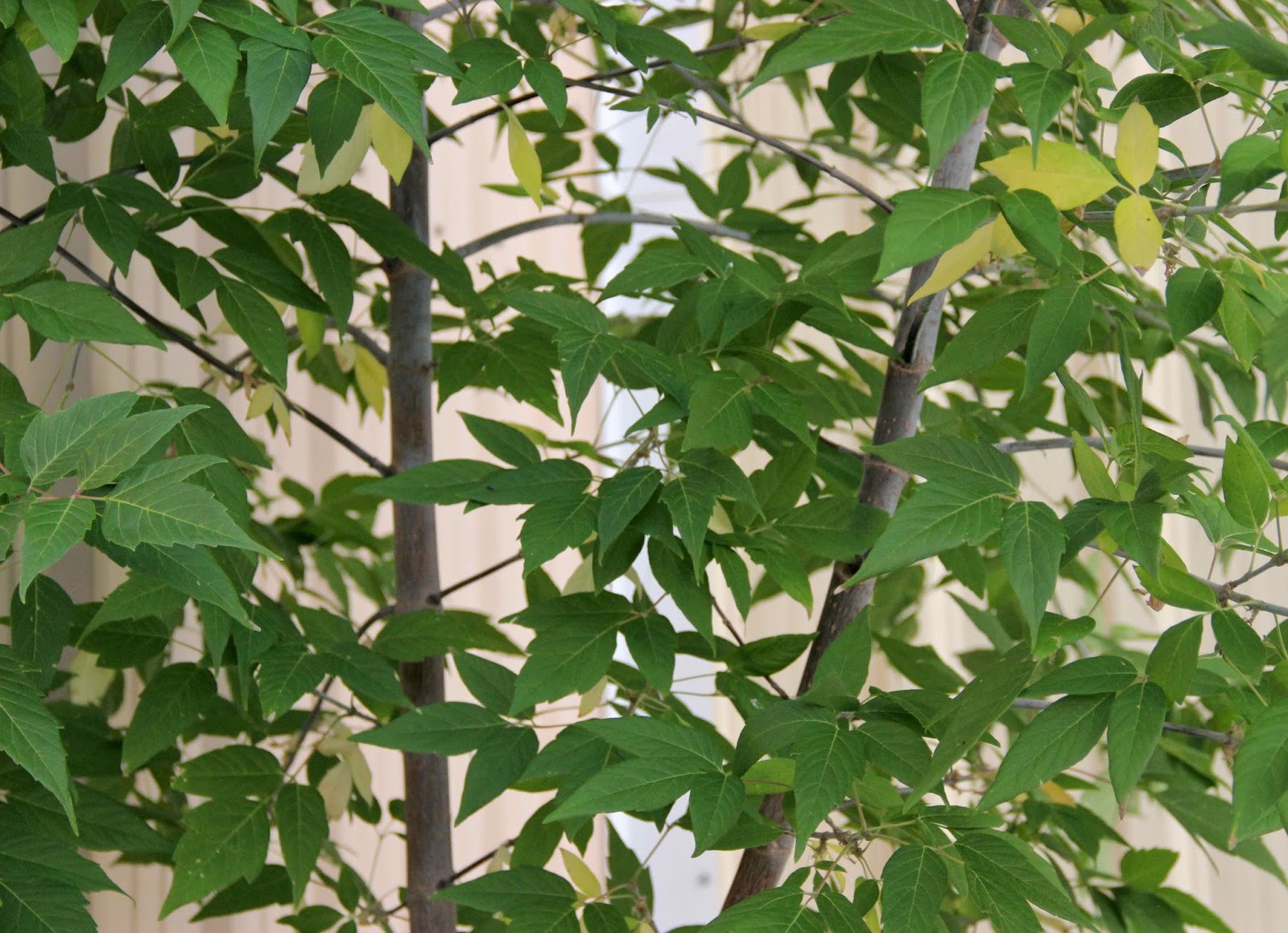
box elder (Acer negundo): A tree. “box” because its wood was used to make boxes; “elder” because the leaves suggest those of elderberry.
Another name for box elder is ash leaf maple, appropriately.  It's a maple (genus Acer) but the leaves look more like ash leaves—compound with leaflets.  Most maple leaves are simple.


Box elder is fast-growing, soft-wooded, short-lived.  “It typically occurs in moist to wet soils along streams, river flood plains and in low woods” (source).  In general, it thrives in open sites on bare soil.  So it’s a capable urban pioneer—a street plant.


One of my neighbors is a boxelder.  It grows just across the street, on the west side of the warehouse in a corrugated metal corner below the sky, with other tough urban types: Canada thistle, curlycup gumweed and trash.

Box elder with pink thistle, yellow gumweed and cheap throw-away stringer pallets.

Barn swallows roost close by in the evening.

Swallows all in a row, above door.

Wildfires are burning 500 miles to the west, so the sky was smoky, with an eerie red sun.

Sun sets behind abandoned cabin and discarded pallets.

This post is my contribution to the August gathering of street plant fans, kindly hosted by Lucy  of Loose and Leafy.

Monday, July 6, 2015

While no one was watching


This spring the Laramie River flooded, as it does most years.  The City closed the walking path, so no one watched the grass.  Ignored, and with all the rain, it thrived.


I am the grass; I cover all.
Carl Sandberg, Grass

Monday, June 22, 2015

Take Back the Street

Asphalt is sometimes referred to as a flexible pavement. This is due to its ability to largely resist the stress imposed by slight settlements of the subgrade without cracking [italics added] – European Asphalt Pavement Association
Yeah right ... we'll show the EAPA what we can do!

A crack in the asphalt snakes all the way across Flint Street from my curb.  Pioneer plants seized the opportunity as soon as a bit of habitat appeared.  Now there’s a winding lineup of greenery.  It’s the usual bunch.

Cheatgrass (Bromus tectorum) gone to seed,
in a patch of large-bract verbena (Verbena bracteata).
Verbena flowers are only a few millimeters across.
Tumble mustard (Sisymbrium sp.) with a flower 5 mm across, and young capsules.
These mustards usually grow much taller, but being a pioneer species, they adapt.
Kochia weed (Kochia scoparia) is the most common pioneer plant in my yard.
In the right situation it grows into a tumbleweed.  This one probably won’t.
Prostrate knotweeds (Polygonum aviculare) in lower crack.
Tiny Russian thistle (Kali tragus, syn. Salsola kali) in crack above. 
Russian thistle in center of photo.  The little seedling looks innocent enough,
but in maturity it will be prickly with sharp spine-tipped leaves.
This is the iconic tumbleweed of the American West.

Nothing’s permanent, everything changes.  Asphalt gives way to pioneer plants.  Pioneers are replaced by bigger, longer-lived plants when there's enough space, dirt and debris.  Since the City appears to be ignoring this botanical invasion, the plants may well take back the street.

The crack widens on the south side of the street, with almost enough plants to be vegetation.
Dandelion and cheatgrass thrive in the asphalt ecosystem.


This post is my contribution to Lucy Corrander’s June street plants gathering.


Saturday, May 23, 2015

Stuck


We must stand in one place.  Feet are not to move unless one is about to fall over.  If we meet this requirement, we can photograph whatever interests us.  These are instructions for the Stuck Foot meme hosted by Lucy Corrander.  I already participate in her other ones – Tree Following and Street Plants, and that had seemed like enough.  But Lucy is a persuasive person, with her enthusiasm and neat ways of looking at things.  So here I am … stuck.


It occurred to that me that if I were stuck in the right place, I could put together a post for this blog which I’ve ignored since its debut a month ago.  So when I dropped off my car for an oil change, I pulled out the bike and pedaled off to a spot with urban plants and rocks.  Traffic was steady and several people went in and out of the building, but no one asked what I was doing.


I stood next to a simple attractive block structure containing plants, rocks and a sign.  The rocks and sign looked intentional, but the plants were weedy species and I think they planted themselves (street plants).

Cheatgrass, Bromus tectorum, may be the most common street plant in Laramie.

The low plants between rocks and blocks are povertyweed, Monolepis nuttaliana.

Ancient water-worn rock with young grass.

A dead plant lay on the rim of the structure.  Had someone made a start at weeding?  The sprawling plant lower left is povertyweed.  Tansymustard (Descuriania sp.) was growing here too, but out of sight.  That’s my bike in the background.


The one exception to the weeds was fringed sagebrush, Artemisia frigida – the silvery plant behind the shaded boulder in the lower left corner of the next photo (click on image to view).  It's a small shrub of the prairie, but sometimes shows up in town.

Andele Rapido (AHN-de-lay RAH-pee-doh) is the fast food version of Corona Village Mexican Restaurant.
Both are highly recommended.

Patterns and shapes often catch my eye, especially in urban landscapes.  Carefully framed they can be intriguing.  But if the colors are dull, will the photos be dull too?

“Much is missed if we have eyes only for the bright colors.” Eliot Porter


Still life with aggregate and asphalt.


Oh look, there’s a pine cone in this last photo.  That's interesting ... I don't remember seeing pine trees.  Ah, mystery!


To see what other Stuck Foot bloggers found, visit our gathering (you may want to join us).